Abu Dhabi
AUH
Abu Dhabi Zayed International Airport

United Arab Emirates
Departures


Arrivals

Abu Dhabi Zayed International Airport
Abu Dhabi Zayed International Airport (AUH) serves Abu Dhabi, the capital of the United Arab Emirates, and lies about 20 miles from the city center. The airport sits at an elevation of 88 feet above sea level, a low altitude typical of coastal Gulf airports.
AUH functions as a major international hub with no meaningful domestic component, connecting the Middle East to destinations across Europe, South Asia, and North America. Traffic patterns show strong links to major European cities, a dense network across the Indian subcontinent, and long-haul connections reaching into North America, reflecting the airport's role as a bridge between East and West. The presence of multiple flights to and from South Asian cities points to substantial demand tied to labor migration and diaspora travel, while European routes underscore its position as a stopover point for travelers heading further afield. The concentration of flights operated by the national carrier highlights the airport's role as that airline's principal base, with its network radiating outward to intercontinental markets rather than serving short regional hops. Travelers passing through AUH can expect an airport oriented toward long-haul connections rather than point-to-point regional travel, with wide-body aircraft operations common given the distances involved. The low elevation and coastal desert setting mean the airport experiences the climatic conditions typical of the Arabian Peninsula, with limited terrain-related influences on approach and departure paths given its flat surroundings.
Height above sea level
88 ft
Distance to city
20 miles
Traffic volume
200 flight per day
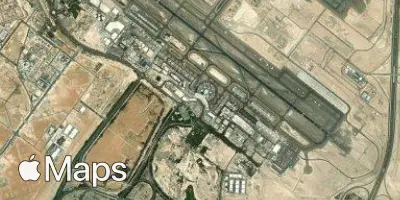
Satellite